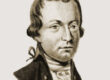
Student of the Jesuit College at St. James’s (1767–1773)
Gracious, mighty gentlemen!
The greatest reward for my mathematical endeavors thus far is the permission to publicly declare that I have become a thorough teacher of higher education at the Ljubljana Lyceum. For this, I am grateful solely to the noble kindness of Your Highness, who, in valuing education and science, knows how to convey this honor with both enthusiasm and composure.
Entry into this institution is such that one joins the spiritual order and commits with soul and body.
This follows the power of the truest love for the enlightened national direction and education.Your Highness’s most humble servant,
Jurij Baron VegaDedication to the Estates of Carniola: August 23, 1800
Jurij Vega was born on March 23, 1754, in Zagorica near Dolsko, into a poor peasant family. His parents were Jernej and Helena Vega.
In 1767, at the age of 13, he began a six-year program at the Jesuit lower school (‘gymnasium’) at St. James’s in Ljubljana.
During his time there, the Jesuits had begun placing greater emphasis on mathematics and natural sciences in the final two years of the humanistic program.
In addition to mathematics and natural sciences, he also studied Latin, Greek, religion, German, history, and geography.
At the time, the school had over 500 pupils, and no tuition fees were charged.
One of his classmates was the writer and historian Anton Tomaž Linhart, who attended the Jesuit gymnasium in 1772–1773.
After finishing gymnasium, Vega went on to study philosophy and mathematics from 1774 to 1775, completing his studies with distinction.
Between 1775 and 1780, he taught logic and rhetoric at the noble college of St. Sava in Ljubljana, where he worked alongside prominent scholars such as Gabriel Gruber and Jurij Golovec.
On 7 April 1780, Vega joined the imperial artillery in Vienna. During his military service, he authored the four-volume mathematics textbook Vorlesungen über die Mathematik (Lectures on Mathematics).
On 20 August 1789, Vega calculated the number π (pi) to 140 decimal places, setting a world record that stood for 52 years (until 1841). His methods are still cited today in the history of mathematics.
In 1781, he advocated for the introduction of the metric system in the Habsburg monarchy. Although his proposal was not implemented at the time, the system was officially adopted much later, in 1871, under Emperor Franz Joseph I.
His most important work, the logarithmic tables Thesaurus Logarithmorum Completus (The Treasury of All Logarithms), was published in Leipzig in 1794.
For his exceptional military and scientific service, Vega was awarded the hereditary title of baron, granted a coat of arms, and promoted to the rank of lieutenant colonel on 22 August 1800.
He died in 1802 in Vienna under mysterious circumstances. His body was found in the Danube River, and the exact cause of his death remains unknown.
Note:
Since May 9, 2001, asteroid 14966 has been officially named Jurijvega, discovered by Herman Mikuž on 30 July 1997 at the Črni Vrh Observatory.
This post is also available in DE, ES, FR, SI, IT, PL and SI.