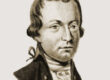
Student of the Jesuit College at St. James’s (1651–1653)
Johann Weikhard von Valvasor was born in May 1641 in Ljubljana. He was a descendant of an old noble family from Bergamo.
His education at the Jesuit college in Ljubljana provided a strong foundation for his later work in the sciences and humanities. Valvasor became a polymath, illustrator, collector, and publisher.
His connection to the Jesuit college and the Church of St. James in Ljubljana is also evident in his design of the pedestal and column, and in the modeling of the statue of the Virgin Mary, which was commissioned by the provincial estates in gratitude for victory over the Turks in 1664. The statue was erected in front of St. James’s Church.
After completing grammar school, Valvasor embarked on a lengthy journey across Europe, during which he met many notable individuals. He later joined the army as a volunteer alongside other Carniolan nobles. He trained under Nikola Zrinski and took part in the Austro-Turkish War in Slavonia between 1663 and 1664.
Valvasor continued his travels throughout Europe and North Africa. Upon returning to Carniola, he married, purchased Bogenšperk Castle, and acquired a house in Ljubljana. At Bogenšperk, he established a publishing workshop and copperplate engraving studio, where he produced 15 books, including his magnum opus, the “The Glory of the Duchy of Carniola” (Die Ehre des Herzogthums Crain, 1689), a monumental encyclopedic work.
In these volumes, he also wrote about his education in Ljubljana, crediting the Jesuit fathers for their role in educating generations of children.
He collaborated with many scholars from Jesuit educational centers, including Pavao Ritter Vitezović, with whom he worked on topographic maps for the Glory of the Duchy of Carniola.
Valvasor was a brilliant researcher. One of the highlights of his scientific work was his study of Lake Cerknica, which earned him international acclaim. In 1687, he was elected a fellow of the Royal Society of London, one of the highest scientific honors of the time.
Due to his outstanding contributions to Slovene science and culture, Valvasor is considered one of the key historical figures in Slovenian history. He was portrayed on the 20-tolar banknote during the Slovene currency period.
Baron Johann Weikhard von Valvasor died in September or October 1693 in Krško, where he spent the final months of his life.
This post is also available in DE, ES, FR, SI, IT, PL and SI.