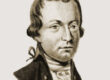
Student at the Jesuit College at St. James’s, Ljubljana (1719–1721)
Ferdinand Augustin von Hallerstein was born in August 1703 in Ljubljana, but spent much of his youth in Mengeš. He was a renowned astronomer, Jesuit missionary, scientist, mathematician, cartographer, and diplomat.
He attended elementary school in Mengeš and later studied philosophy and the humanities at the Jesuit College at St. James’s in Ljubljana.
In 1721, he entered the Jesuit order. He pursued further studies in Vienna and Graz, and for a time taught grammar as a Jesuit instructor.
He chose a missionary path, requesting a post in the Jesuit missions in China. He arrived in Beijing in 1739, where he soon became the head of the Chinese Imperial Astronomical Bureau (the “Tribunal of Mathematics and Astronomy”), and later a mandarin—a high-ranking civil servant in the Chinese administration.
Hallerstein earned imperial recognition after he made the most accurate prediction of a solar eclipse, outshining both local Chinese and other Jesuit scientists. This achievement led the Emperor to appoint him as director of the imperial observatory in 1746. His prestige grew, and he was granted the title of mandarin, a rare honor for a European.
In 1749, Hallerstein surveyed and mapped large areas of China, contributing to the comprehensive Chinese atlas published in 1769. He also took part in the publication of a star catalogue containing 3,083 stars in 1757, and in 1768, a collection of astronomical observations made by Jesuits in Beijing was published in Vienna.
In addition to his astronomical work, Hallerstein also compiled important demographic and statistical records. In 1761, using Chinese tax registers, he calculated the total population and annual growth rate of China. He was the first European to accurately report China’s population, sparking interest—and some concern—in Europe and China alike. His publication of detailed population lists even raised security concerns within the Chinese empire.
Hallerstein maintained active correspondence with many of the leading European scientific academies of his time. He was elected a foreign member of the Imperial Academy of Sciences in Saint Petersburg, and corresponded regularly with both the Royal Society of London and the Académie des Sciences in Paris.
Ferdinand Hallerstein died on October 29, 1774, and was buried in the Jesuit cemetery in Beijing. His tomb bears inscriptions in both Latin and Chinese, naming him as Ferdinandus Augustus Hallerstein and Liu Songling.
This post is also available in DE, ES, FR, SI, IT, PL and SI.