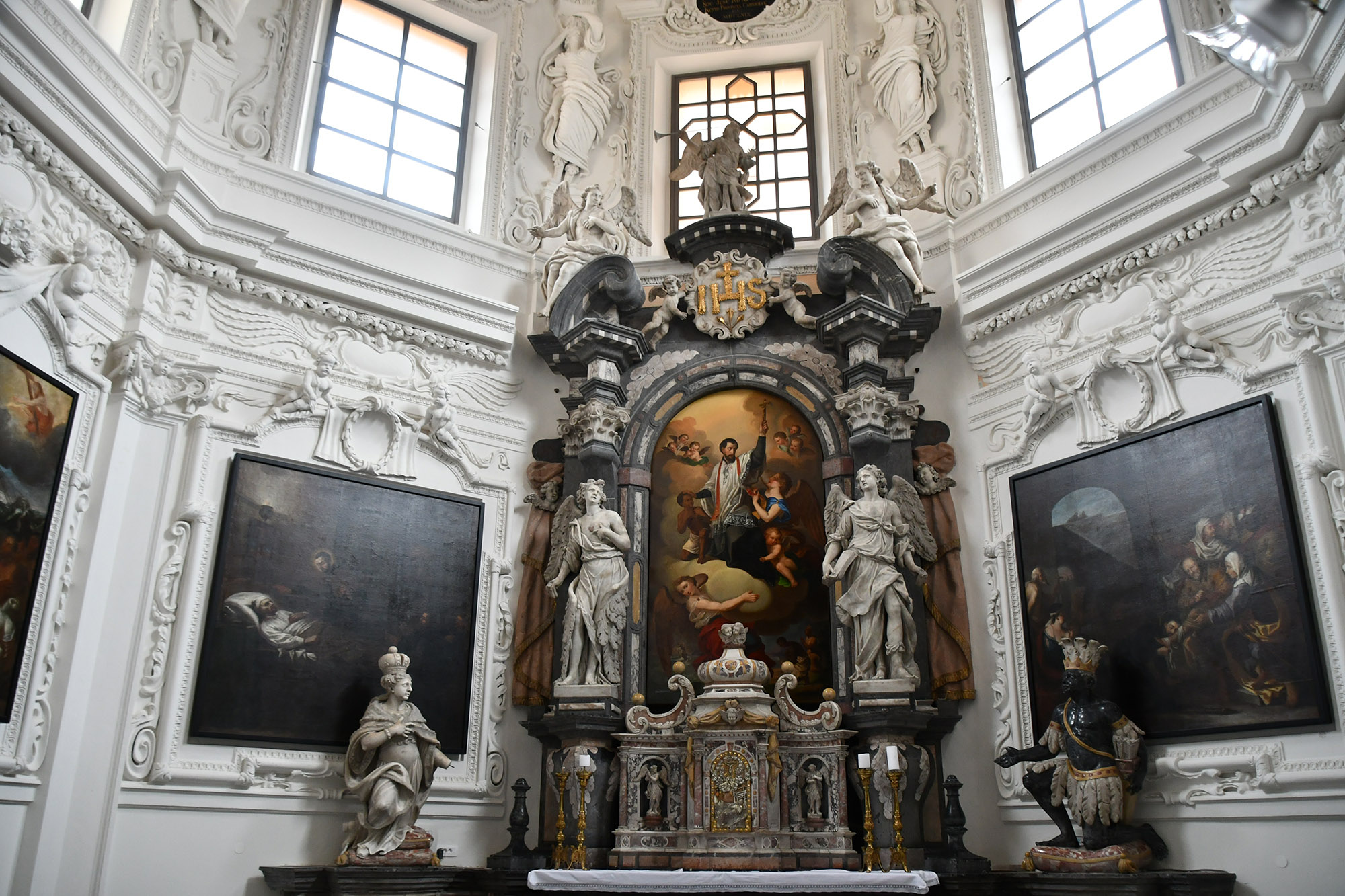
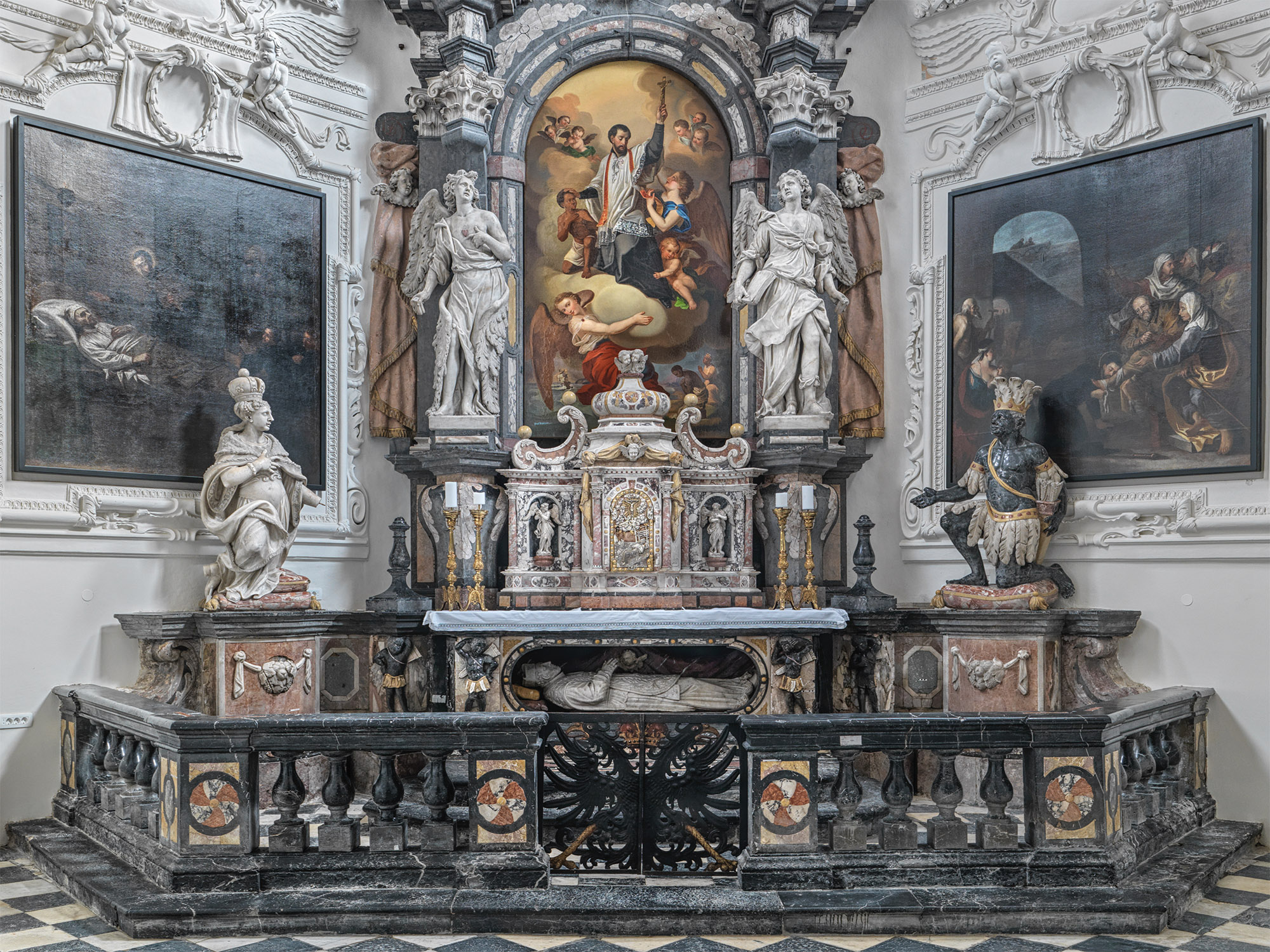
The Altar of St. Francis Xavier was created in the early 18th century.
Its central element is a mensa with the statue of the saint in priestly vestments, evoking his incorrupt body in Goa.
Flanking it are a seraph and a cherub by Paolo Gropelli.
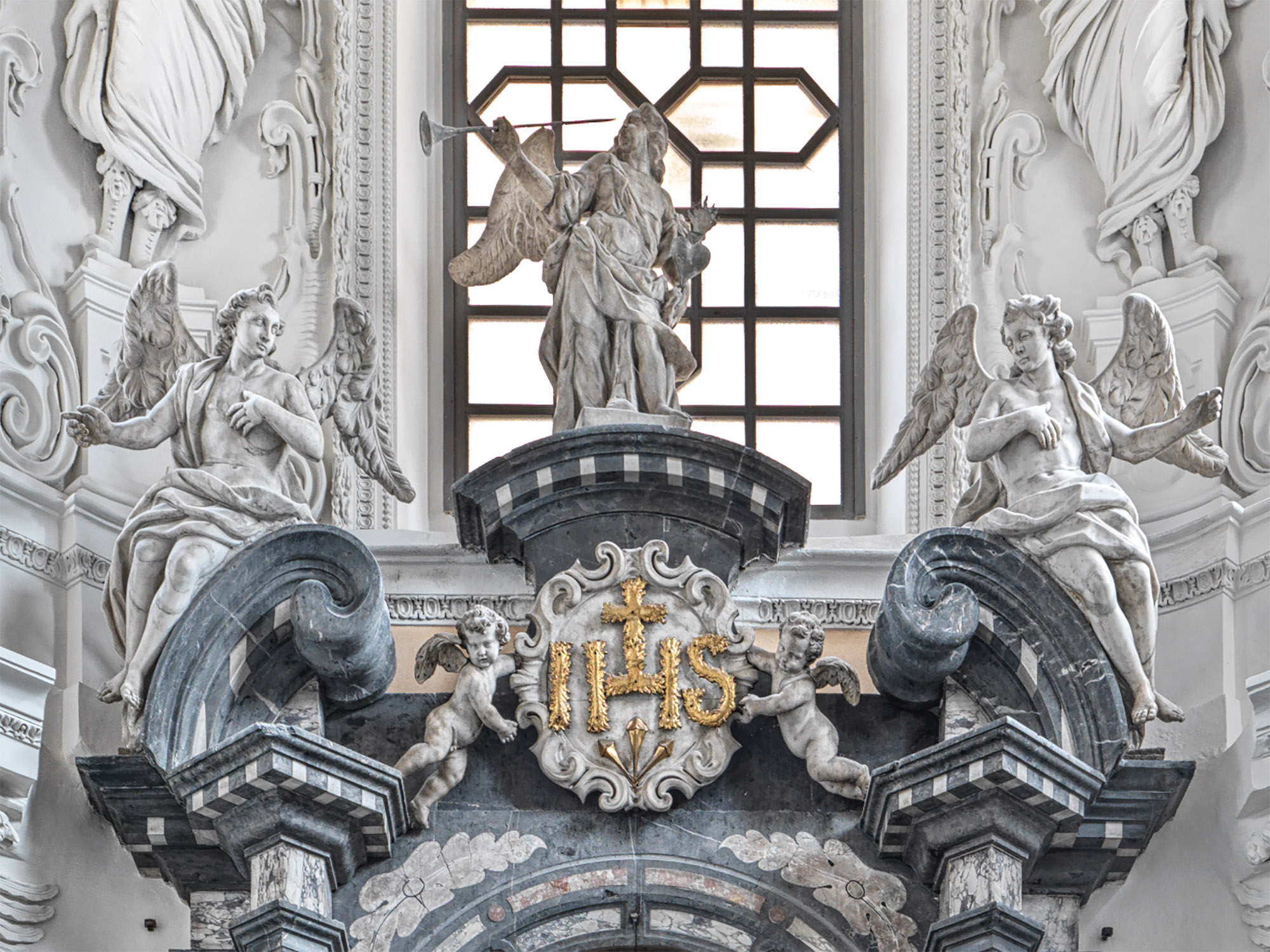
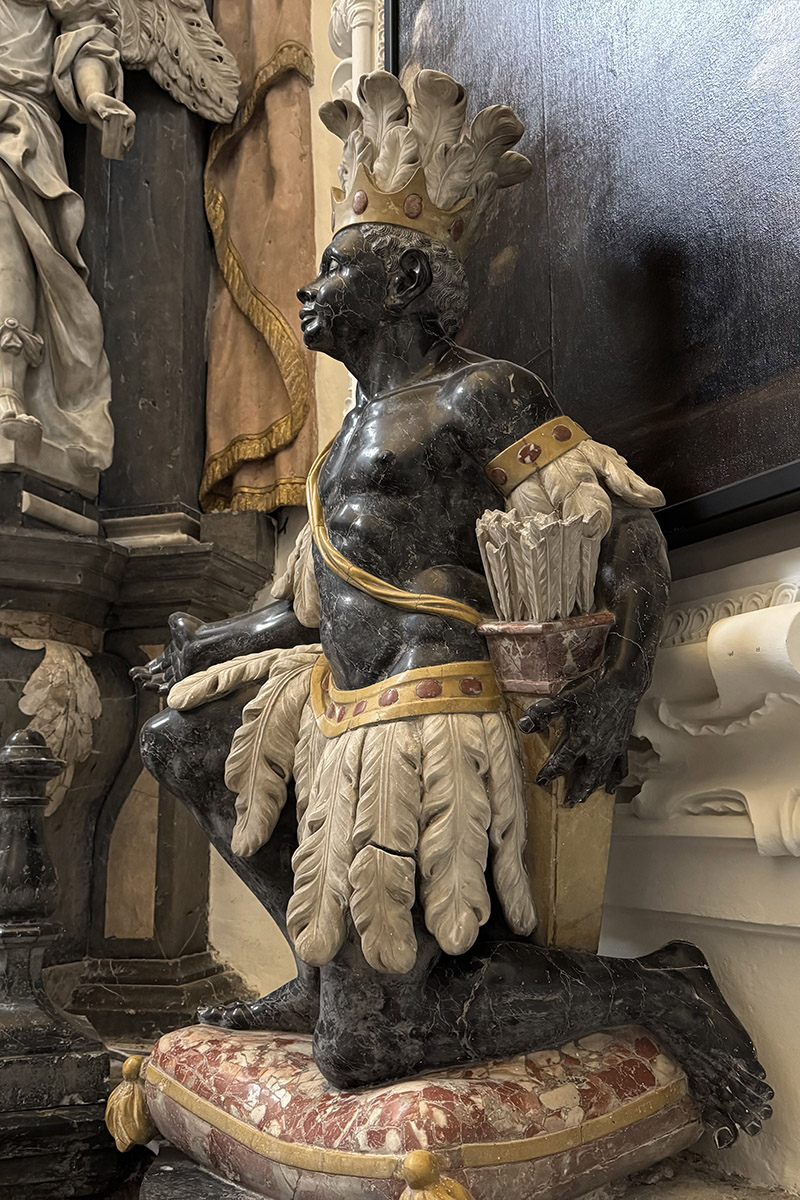
The tabernacle was expanded by Jacopo Contieri, who also sculpted the allegories of Europe and Africa. At the top stands a trumpet-blowing angel by Angelo Putti.
The altarpiece is work of Paul Kühn (1860).
The altar reflects deep devotion and missionary zeal with rich artistic and theological symbolism.
The Altar of St. Francis Xavier is an exceptional work of art from the early 18th century, combining sculptural, pictorial, and architectural mastery. It was commissioned by Carolus Enders, rector of the Jesuit college in Ljubljana, and the architectural design was executed by stonemason Franc Grumnik. The altar was constructed over more than a decade (1709–1722) with the contribution of renowned artists from Venice and Padua.
At its center stands a mensa supported by four Moors, containing a representation of St. Francis Xavier in priestly vestments—not depicted as dying, but as already deceased, in reference to the incorrupt relics of his body preserved in Goa since 1637. Above the mensa rise two pedestal-like forms with the figures of a seraph and a cherub, replacing the traditional columns. Both angel statues were created by Paolo Gropelli, who gave them expressive Baroque dynamism. The black stone tabernacle was expanded in 1719 with marble niches containing two angels sculpted by Jacopo Contieri. He also added the allegorical figures of Europe and Africa—the fair “queen” and the dark-skinned “king”—symbolizing the spread of the Gospel. Contieri’s signature is engraved on the base of each figure.
The attic of the altar features two seated angels (also by Contieri) and a standing trumpet-blowing angel at the top, created by Angelo Putti. In 1860, painter Paul Kühn added the altarpiece The Exaltation of St. Francis Xavier, which currently hangs in the presbytery due to ongoing restoration works. Kühn is also the author of the Stations of the Cross (1863) in the nearby chapels. Six oil paintings on the chapel walls, created in 1726, depict the miracles of St. Francis Xavier. Their likely author is Daniel Savoy, a Dresden-born artist who converted from Calvinism to Catholicism in this very church.
The altar is a profound expression of Jesuit devotion, linked to the tradition of solemn novenas held before the saint’s feast day, which began around 1700. For these occasions, elaborate temporary decorations were erected, including angelic figures and symbolic representations of continents—elements that were later permanently integrated into the altar’s artistic design.
This post is also available in DE, ES, FR, SI, IT, PL and SI.